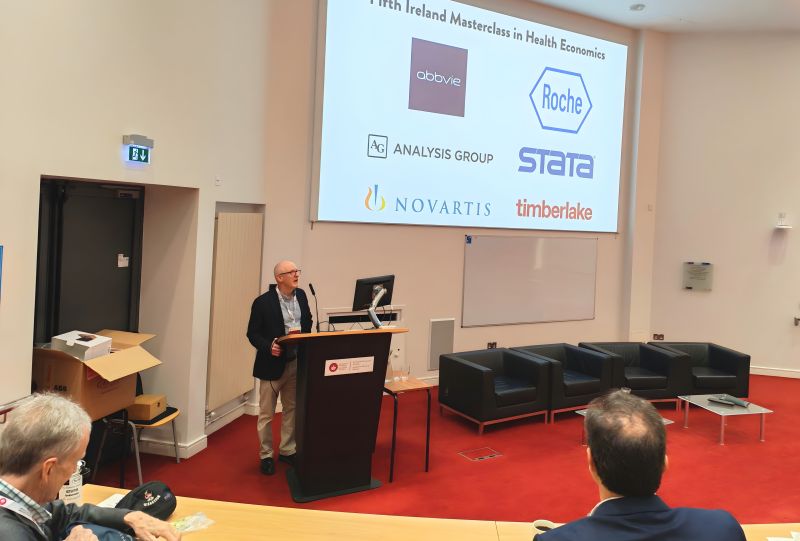
I was fortunate to attend the Fifth Ireland Masterclass in Health Economics. The goal of the series was not to simply to present research. It is to broaden the horizons of younger scholars and give established researchers the space to discuss the larger questions that often get lost in a traditional conference setting. Rather than focusing on results, speakers spent time discussing methods, and the craft of choosing research questions.
A few lessons I am taking home:
- Perspective
One of the most valuable aspects of the Masterclass was exposure to ways of thinking about health economics that receive less attention in my own academic environment.
As researchers in the United States, it is easy to become accustomed to the institutions around us and to treat our questions as universal. This week reminded me that they are not. Different healthcare systems create different constraints, different incentives, and ultimately different research agendas.
Presentations by Ciaran O’Neill, Mark Sculpher, Edel Doherty, and others highlighted questions that receive comparatively less attention in many American graduate programs. Not simply whether a policy works, but how we measure health, how we value outcomes, and how governments should allocate scarce resources when every choice carries tradeoffs.
The experience reminded me that health economics is much broader than the collection of methods we happen to use most often. Different institutions create different priorities, and different priorities create different research traditions. There is a great deal to learn from both.
2. Artistry
Research is not only a science. It is also a form of communication.
Economists spend enormous effort refining identification strategies, data construction, and empirical methods. These tools matter. But they are ultimately in service of a larger goal: producing knowledge that can improve lives.
The audience matters. The way we explain an idea to fellow economists should differ from the way we explain it to policymakers, healthcare administrators, physicians, or the public. Good research is not only rigorous. It is understandable by the people who can act on it.
3. Validity
One theme appeared repeatedly throughout the week: credibility is more important than excitement.
A carefully executed paper with a null result, precision and, high-quality data, and meaningful external validity contributes more to oaur understanding than a flashy result built on weaker foundations.
As economists, we often speak about identification. We should speak just as often about applicability. If our findings cannot travel beyond the setting in which they were discovered, their ability to improve policy and practice is limited.
I left with both inspiration and a broader perspective on the field I have greatly enjoyed.


 David Robinow